
Let’s start with a story about scoring frameworks. Who doesn’t love that?
Not too long ago, product teams discovered a powerful way to prioritize projects: the ICE Scoring Model. Created by Sean Ellis, growth-hacking godfather, ICE was designed for speed and simplicity. Its magic lies in three simple factors: Impact, Confidence, and Ease.
Down to its bare bones, the ICE framework works like this:
- Rate each potential project from 1-10 on those three dimensions.
- Multiply the scores.
- Higher number wins.
The ICE method is truly great for rapid experimentation and prototyping.
But as with all models, ICE has limitations. Excitement was neglected. A transformative project could get killed because no one on the team truly cared about it (that’s for an entirely different article). Passion? Missing from the equation.
While this was on purpose – “passion” can lead to significant bias – when going through the ICE method, there is human bias in each of the rankings. It’s who we are, hunches and gut feelings can play a role. And that can be “okay”.
Enter EPIC: The Next Evolution of Project Prioritization
EPIC isn’t just a tweak to ICE. It’s reimagining how teams choose which projects to pursue.
Breaking Down EPIC
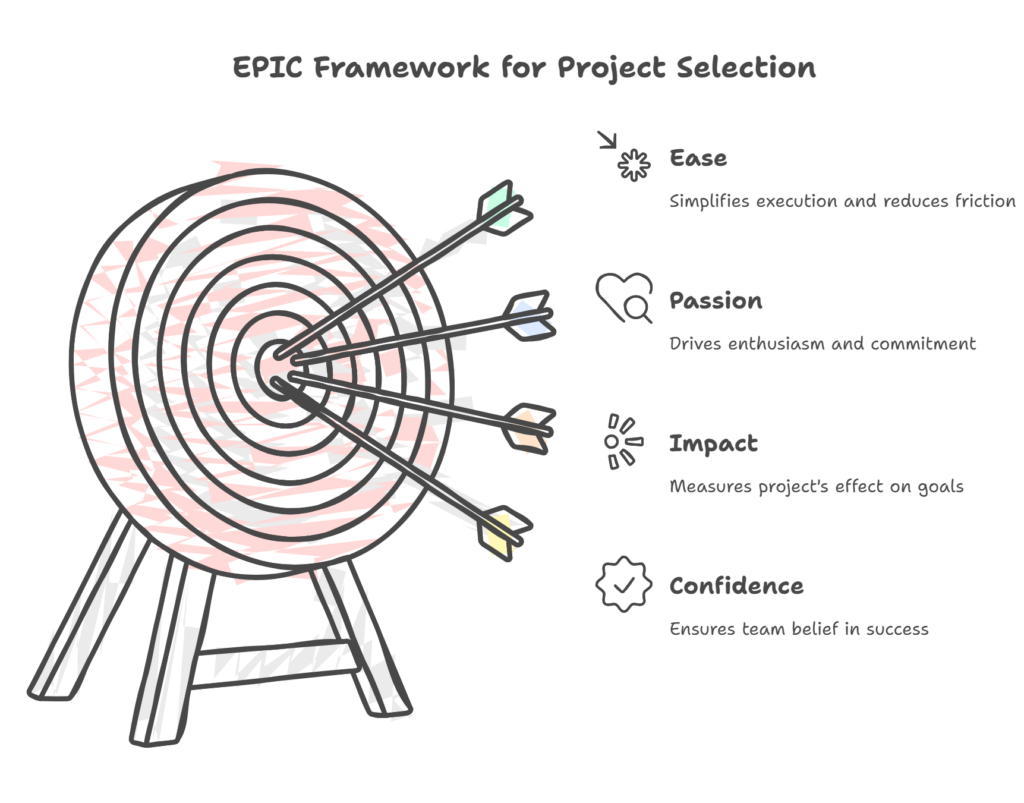
EPIC stands for Ease, Passion, Impact, and Confidence—but it’s far more than just another acronym. It’s rethinking of how teams choose projects and what motivates them, putting human energy at the heart of decision-making.
Passion Changes Everything
At their core, traditional scoring models are like robots trying to make human decisions. They crunch numbers, rank ideas, and miss the most critical ingredient: genuine excitement. And for good reasons, humans can make silly decisions when not backed by data.
Passion isn’t just a feel-good word. It’s the rocket fuel that helps transforms good ideas into great achievements and gets them to the finish line. When we disregard how much we care about a project, even the best laid plans can become zombies. They are alive and moving, but nothing is between their ears, they lack the game-changing spark.
As Steve Jobs, former CEO of Apple said, “What’s needed is people who have a sense of adventure. People who firmly believe in their product and mission. People who, win or lose, are all in it together with great enthusiasm.“
Consider those marathon projects that seem impossible. We’ve all been there. The big, hairy, audacious goals that make team members say “WTF” when they first hear about them. The pit that instantly forms in their stomach. The “Great, I’m glad the corporate overloads are just throwing this on us to add with the 23 other projects from last quarter”. How do these projects get accomplished? Sure, they can be accomplished by fear of losing employment – what a great working environment – or they are accomplished by those that pick put the standard and are genuinely committed to seeing it through.
Think about it. Remember the most transformative projects or teams you’ve been part of? That electricity in the air. The team is completely fired up. There was energy that pushed everything forward, turning every challenge into something that truly made the project better.
That’s where EPIC comes in. It doesn’t try to eliminate human emotion from the process. It harnesses that emotion and makes it a part of the winning recipe.
When projects hit rough patches—and they always do—it’s passion that provides the grit to push through. It’s determination that turns “this might work” into “wow, look how much we’ve accomplished in so little time.”
EPIC tries to ensure that the initiatives your team pursues are both strategically sound and motivating.
As I will allude to later, passion isn’t a blank check. Not every passion project deserves to be acted upon – which is where the teams’ experience and history comes into the decision-making model. But if you can blend passion with clear-eyed assessment – easier said than done – your team will be unstoppable.
Ease (E): How much will it impact the team’s workload?
Not all projects are quick wins. Some are marathons, others are sprints. Ask yourself:
- How much time and/or resources will this really take?
- How much workload will this add to the team?
- Are we going to disrupt our entire workflow?
Then rate how “easy” the idea or tactic will be to create and implement.
- 1-2: This project will take considerable time / resources and could take the team 6 months or longer to complete.
- 3-5: This project will still be a significant lift for the team and could take a quarter to complete.
- 6-7: This project can get rolled out relatively quickly, taking the team a month to complete.
- 8-10: This is a short-term project that can take as little as a few weeks to complete.
Passion (P): Are We Actually Excited?
Passion isn’t just a feel-good word – it’s the rocket fuel of project success. Ask your team:
- Do team members light up when discussing this project?
- Is there a true believer who will champion this idea?
- Does it align with why we do what we do?
Then rate how much “passion or excitement” the team has for the idea.
- 1-2: This project elicits a “blah” reaction from the team with no real champion in the group.
- 3-5: This project is “okay”. People are indifferent about it and could get behind it as it takes off.
- 6-7: This project elicits positive reactions amongst the team and people are generally excited about it.
- 8-10: We are 100% on board and bought in.
Impact (I): What’s the Potential Payoff?
Beyond the numbers, what meaningful change could this project create for the team or the company as a whole?
- Will this solve a real problem?
- What’s the potential return on investment?
- How will this move the needle for our customers or organization?
Then rate how much “impact” the project will have for the team and/or company.
- 1-2: Super low impact.
- 3-5: Minimal impact.
- 6-7: Considerable impact that will be measurable.
- 8-10: This project significantly moves the needle.
Confidence (C): Can We Really Pull This Off?
Reality check time. Excitement needs to meet capability. Some projects are transformational, but the team just isn’t ready for them… yet.
- Have we done something like this before?
- Do we have the skills and resources?
- Are we dreaming or doing?
Then rate how much “confidence” the team has in being able to deliver. Weighing the time and resources put into this, how confident are you that it will succeed.
- 1-2: Low confidence.
- 3-5: Minimal confidence.
- 6-7: We believe we can accomplish it but have a few doubts we need to consider.
- 8-10: The team has significant confidence in being able to complete the project.
The EPIC Scoring Magic
Open up a spread sheet and list the projects and a column for Ease, Passion, Impact, and Confidence. Score each factor from 1-10 (10 being high), then use this simple formula:
Ease x Passion x Impact x Confidence
That’s it. Super simple and to the point.
Higher scores mean: “Hell yeah, game on!” Lower scores mean: “Put it on the list for later.”
Handling Team Disagreements
This is going to happen. It happens with ICE, it happens with EPIC, it happens every time a team gets together to make future decision – and that can be magical in its own way. To mitigate scoring conflicts, implement a collaborative scoring process. If you already have them, send out project ideas before the team meeting so individuals can score them objectively. Once that is done, have a facilitated group discussion where team members explain their rationales.
If you simply can’t get to an agreement, just use the average score or the team lead can make the final call (the former is preferable for buy in). The key is creating a transparent process where each team member feels heard while not taking 3 days to complete the process. We still want to keep the process relatively quick.
While this added exercise adds more time (resources) to the decision-making process, it helps keep the motivational benefits of passion while introducing necessary critical thinking that results in more team buy-in.
EPIC Caution
Just like ICE, one drawback of decision-making models is that they are subjective. One day project 1 might be the winner but in two weeks as moods change, or new data comes to light it might take a backseat to project 2. That’s life. Things chance. Moods change. Information changes. Organization priorities can change. You need to be agile and flexible with change if significant information comes to light that changes the organization’s outlook.
The Real Win: Bringing (Some) Humanity Back to Projects
ICE and other models are great, they really are. Maybe it’s my emotional side or the nostalgia of working on transformative projects I was truly passionate about that mattered that want me to go farther than ICE to EPIC.
EPIC can help. It can help create that feeling that “we got this” environment where the team is on board, motivated and aligned.
Traditional scoring says: “These numbers look good.” EPIC says: “We’re excited, we can do this, and it matters.”
Stop trudging through project to-do lists. Start working on projects that bring the team to life.
Your team doesn’t want another task to add to their already growing list. They want to be heard. They want to get behind a mission.
You can give that to them.
What do you think? Our we way off base? I’d love your feedback. Let me know here.